 |
Commemorated on June 3
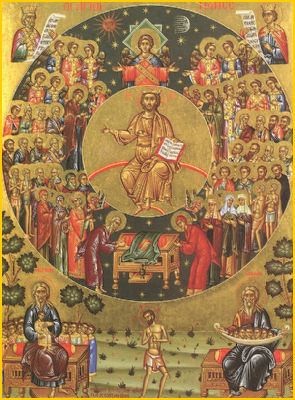
The Sunday following Pentecost is dedicated to All Saints, both those who are known to us, and those who are known only to God. There have been saints at all times, and they have come from every corner of the earth. They were Apostles, Martyrs, Prophets, Hierarchs, Monastics, and Righteous, yet all were perfected by the same Holy Spirit.
The Descent of the Holy Spirit makes it possible for us to rise above our fallen state and to attain sainthood, thereby fulfilling God's directive to "be holy, for I am holy" (Lev. 11:44, 1 Peter 1:16, etc.). Therefore, it is fitting to commemorate All Saints on the first Sunday after Pentecost.
This feast may have originated at an early date, perhaps as a celebration of all martyrs, then it was broadened to include all men and women who had borne witness to Christ by their virtuous lives, even if they did not shed their blood for Him.
St. Peter of Damascus, in his "Fourth Stage of Contemplation," mentions five categories of saints: Apostles, Martyrs, Prophets, Hierarchs, and Monastic Saints (from the Philokalia). He is actually quoting from the Oktoikhos, Tone 2 for Saturday Matins, kathisma after the first stichology.
St Nicodemus of the Holy Mountain (July 14) adds the Righteous to St. Peter's five categories. The list of St. Nicodemus is found in his book The Fourteen Epistles of St Paul (Venice, 1819, p. 384) in his discussion of I Corinthians 12:28.
The hymnology for the feast of All Saints also lists six categories: "Rejoice, assembly of the Apostles, Prophets of the Lord, loyal choirs of the Martyrs, divine Hierarchs, Monastic Fathers, and the Righteous…."
Some of the saints are described as Confessors, a category which does not appear in the above lists. Since they are similar in spirit to the martyrs, they are regarded as belonging to the category of Martyrs. They were not put to death as the Martyrs were, but they boldly confessed Christ and came close to being executed for their faith. St Maximus the Confessor (January 21) is such a saint as are many of the New Russian Confessors.
The order of these six types of saints seems to be based on their importance to the Church. The Apostles are listed first, because they were the first to spread the Gospel throughout the world.
The Martyrs come next because of their example of courage in professing their faith before the enemies and persecutors of the Church, which encouraged other Christians to remain faithful to Christ even unto death.
Although they come first chronologically, the Prophets are listed after the Apostles and Martyrs. This is because the Old Testament Prophets saw only the shadows of things to come, whereas the Apostles and Martyrs experienced them firsthand. The New Testament also takes precedence over the Old Testament.
The holy Hierarchs comprise the fourth category. They are the leaders of their flocks, teaching them by their word and their example.
The Monastic Saints are those who withdrew from this world to live in monasteries, or in seclusion. They did not do this out of hatred for the world, but in order to devote themselves to unceasing prayer, and to do battle against the power of the demons. Although some people erroneously believe that monks and nuns are useless and unproductive, St. John Climacus had a high regard for them: "Angels are a light for monks, and the monastic life is a light for all men" (Ladder, Step 26:31).
The last category, the Righteous, are those who attained holiness of life while living "in the world." Examples include Abraham and his wife Sarah, Job, Saints Joachim and Anna, St. Joseph the Betrothed, St. Juliana of Lazarevo, and others.
The feast of All Saints achieved great prominence in the ninth century, in the reign of the Byzantine Emperor Leo VI the Wise (886-911). His wife, the Holy Empress Theophano (December 16) lived in the world, but was not attached to worldly things. She was a great benefactor to the poor, and was generous to the monasteries. She was a true mother to her subjects, caring for widows and orphans, and consoling the sorrowful.
Even before the death of St. Theophano in 893 or 894, her husband started to build a church, intending to dedicate it to Theophano, but she forbade him to do so. It was this emperor who decreed that the Sunday after Pentecost be dedicated to All Saints. Believing that his wife was one of the righteous, he knew that she would also be honored whenever the Feast of All Saints was celebrated.

