



Source: Ancient Faith Radio
February 25, 2011 Length: 101:41
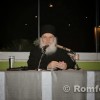
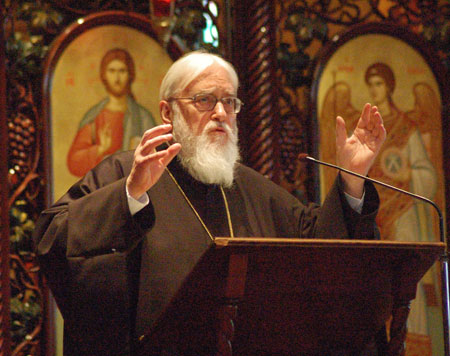 A lecture delivered at North Park University in Chicago in Feb of 2011.
 Direct link
 Play in Popup
 Transcript
Let me begin this evening with words, neither from an Orthodox Christian nor from an Evangelical Christian but from a Roman Catholic—Cardinal Suenens. He has said, “In order to unite, we must first love one another. In order to love one another, we must first get to know one another.” That sums up in a nutshell the purpose of our Orthodox-Evangelical dialogue. As with every Inter-Christian and indeed Inter-faith dialogue, we are seeking to get to know one another better, so that we may come to love another more fully and so may be enabled by God’s grace and mercy to fulfill the prayer of our Lord Jesus Christ for his disciples “that they all may be one”. (John 17:21).
Nowadays, we often hear the word dialogue, used in the title of my lecture tonight. Some people are in favor of dialogue and others are against. For myself, I am strongly in favor. A dialogue that is sincere, a dialogue of love—yes—but also a dialogue of truth, without evasion and without compromise. Let me tell you why I am in favor of dialogue.
Half a century ago, a highly instructive book was written on the Christian understanding of the human person, a book still worth reading and too much neglected. It was by a Scottish philosopher, John MacMurray, entitled Persons in Relation. His theme was “personhood is relational”. As persons, we are what we are only in relation to other persons. No one—isolated, cut off from others, turned inward—is truly a person according the image and likeness of God, the Holy Trinity. Not that John MacMurray actually mentions the Trinity. It would have greatly strengthened his argument had he done so.
The early Christians used to say [0:10:11] unos christianus, nolos christianus—one Christian, isolated and cut off from the others, is no Christian. We can extend that saying—[0:10:29] una persona, nula persona—one person, cut off, isolated from others is not truly a person. As MacMurray puts it, “The self exists only in dynamic relation with the other. The self is constituted by its relation with the other. It has its being in its relationship. There is no true person,” he continues, unless there are at least two persons communicating with one another. To be human is to be dialogic—to engage in dialogue.” And so MacMurray concludes, “I need you in order to be myself.” All of this has been developed from the Orthodox side by the Greek theologian, John Zizioulas, Metropolitan of Pergamon. This theme, that human personhood is relational, is evident in the very word used for “person” in the Greek language. The word for “person” in Greek is prosopon—it means “face” or “countenance”. I am not a person unless I face other persons, unless I look into their eyes and let them look into mine.
Now, we should apply all this, not only to individual persons but to church communities—isolated, cut off from other Christian communities. No ecclesial group is truly fulfilling its vocation in Christ. Each Christian community should be willing to say to the others, “We need you in order to be ourselves.” That can certainly be applied to Orthodox-Evangelical dialogue.
At first sight, Orthodox and Evangelicals appear widely different, even opposed. But, in fact, we share in common far more than might at first seem evident. We share a common faith in God, the Holy Trinity; a common faith in Jesus Christ, as fully and truly God, fully and truly human. We share a common faith in his virgin birth, his miracles, his sacrificial death on the cross for our salvation, his bodily resurrection, his second coming. We share a common faith in Holy Scripture as inspired by God and altogether truthful. But for neither side does this necessarily imply fundamentalism. We share a common faith in the divine ordering of marriage and the family; a common conviction that sexuality is indeed a gift from God, but a gift to be used in the lifelong commitment of marriage. We share a common approach to problems of homosexuality, bioethics, and euthanasia. Yes, there are significant divergences between us. But they are not as great as we might suppose. The present day Anglican Bishop of London, Richard Chartres, has said, “There are two kinds of Christians. On the one side, those who believe that Christianity is a revealed religion and, on the other side, those who believe that you can make it up as you go along.” Well, in regard to that division, Orthodox and Evangelicals come down firmly on the first side.
Of course, as an Orthodox I allow for the fact that there are many variations within Evangelicalism—notably, the difference between Arminians and Calvinists. I am firmly an Arminian. Also, the difference between Charismatics and non-Charismatics. I would put myself in the Charismatic class. Orthodoxy is, of course, much more uniform in doctrine and forms of worship than Evangelicalism. But, here too, we have differences among ourselves, especially in our attitude to non-Orthodox Christians and in our approach to Christian unity and the Ecumenical Movement. Please take note that in the title of my address, I do not say, “What have Evangelicals to learn from the Orthodox?” But I say, “What have we to learn from one another?” Dialogue, if truly such, is always mutual—never just one-sided.
Tonight, let me explore three areas. The list is by no means exhaustive. Let us look at Church and Eucharist. Then, secondly, Scripture and Tradition. Thirdly, the Work of Christ. Here I am trying to follow the advice of the bishop who ordained me priest. At the end of the service, I asked him for guidance in my future ministry. He said (he was not in fact the first person to say this), “Always have three points in your sermon; not less and not more.” [laughter] Actually, I think it’s often quite enough to have one point in your sermon, and some sermons seem to have no point at all! [laughter]
Let’s start with Church and Eucharist—the first item in my list of three. What is the Church here for? What is the unique function of the Church? What is it that it alone does and what no one and nothing else can do? We might answer, “The Church is here to proclaim salvation in Jesus Christ.” That is true, but it is incomplete. We are not here merely to proclaim. Jesus, at the last supper, did not tell his disciples, “Say this.” He told them, “Do this.” He was speaking of the action of the Holy Communion. So the basis of the Church is not just words but an action—the action of the Eucharist to which Baptism is indissolubly linked. It is through these two primary Sacraments of the Church—Baptism and Eucharist—that salvation is made available to us, while on our side is needed the response of faith. So the Church is a Eucharistic organism. Unity is not imposed from above by power of jurisdiction. Unity in the Church is created from within through sharing together in the Sacrament of the Lord’s Body and Blood. So in thinking of Orthodox contacts with the Evangelicals, I feel it is good to start from the Eucharist.
Now, the Orthodox attitude to the Eucharist, to the Divine Liturgy, is well summed up in a sermon preached around the year 864 by St. Photios, Patron of Constantinople. He describes the impression made on him by a newly decorated church in the city. He begins by speaking of the delight and wonder felt by the worshiper on entering the courtyard in front of the church. He stands as if rooted to the ground. “The façade of the church”, he says, “is a new miracle and a joy to see.” “But when, with difficulty,” continues Photios, “one has torn oneself away from there and looked into the church itself, with what joy and trepidation and astonishment is one filled. It is as if one had entered heaven itself.” Now, there are a number of things we may note here. The first is the stress on the visual. The Evangelical tradition relies primarily on the Word spoken and heard. Of course, that is also important for us Orthodox. But we believe that grace is transmitted to us not only through the ear but through the eye. In the words of Photios, we notice the place of beauty in worship. That’s a theme that is dear to the heart of the Orthodox. In a famous statement, the Russian novelist, Theodore Dostoyevsky, said, “Beauty will save the world.”
We notice also in Photios’ account the value of the physical and the material. Icons are very important for Orthodox worship. Relics have a special place. And behind this stress on the value of the physical and material, there is a strong doctrine of creation, as is said in the first chapter of Genesis: “God saw everything that he had made, and, behold, it was altogether good and beautiful.” This doctrine of creation, of course, is highly relevant for the present day ecological crisis. But most important of all in Photios’ account, notice his words, “It is as if one had entered heaven itself.” That is the primary image that Orthodox have of the Church at worship of the Divine Liturgy—heaven on earth, an earthly heaven.
Many of you may know the legendary story of the conversion of Russia. Prince Vladimir of Kiev, still a pagan, sent out his emissaries to the different countries of the world to try and discover which was the true faith. When they came to Constantinople, the Greeks took them into the Great Church of the Holy Wisdom—Hagia Sophia—and there they attended the Divine Liturgy. Returning home, they reported to Vladimir that it was there in Constantinople at the liturgy that they found what they were looking for. “We knew not,” they said, “whether we were in heaven or on earth. For surely there is no such beauty anywhere on the earth. Only this we know: that God dwells there among humankind and that their worship surpasses the worship of all other places; for we cannot forget that beauty.” Heaven on earth—there we come very close to the meaning of the Church for Orthodox Christians. In the words of St. John Chrysostom: “The Church is the place of angels, archangels, the Kingdom of God, heaven itself.”
The Russian bishop in London who died a few years ago, Metropolitan Anthony Bloom, whose writings on prayer are well known has said: “The Church is vast—so vast that it holds both heaven and earth, so vast that people of all nations, of all cultures, of all languages, are at home within it.” Heaven on earth. When we pray, we Orthodox feel that we are joined in our worship by the company of heaven, by the departed as well as the living; hence, in our worship, we always include prayers for the departed. We pray for one another while we are alive. Should we not pray for one another even though some of us have crossed the river of death? And, of course, we include also the invocation of the Blessed Virgin Mary and the saints. We are conscious that they are praying with us, and we are not afraid to ask for their prayers.
Here, I would like to share with you my own experience—the first time I ever attended Orthodox worship. I had been brought up as an Anglican. One Saturday afternoon when I was seventeen, I was wandering through a part of London that I had not previously explored, and I saw a church into which I had never entered. Out of curiosity I went in. It was, in fact, the Russian Church in London. It was a brilliant, sunny afternoon outside. As I entered the church, it was dark within. At first, I could see hardly anything. I only noticed that there were no pews—just a vast expanse of polished floor, because the Orthodox at prayer—at least in the tradition of the original Orthodox countries—usually remain standing. Although this is changing in a country like Greece.
My first impression then was the church is empty. Then I realized it wasn’t entirely empty. Close to the walls, there were a few people (not very many—elderly for the most part) and icons with lamps burning in front of them. Across the east end was an icon screen with many candles in front of it. Somewhere out of sight, a choir was singing. It was, in fact, the normal Saturday evening Vigil service that the Russians celebrate. From behind the icon screen, a deacon came out and intoned a litany. Then, I had an entirely contrary impression from what I had felt initially. With overwhelming conviction I felt: The church is not empty. It is full, full of invisible worshipers. We—this small, visible congregation—are being taken up into an action far greater than ourselves. There is no division, I felt, between earth and heaven. The angels are here praying with us, the saints, the Holy Mother of God, our Lord Jesus Christ himself—we are all participating in one, undivided action.
This is what we Orthodox wish first and foremost to share with our Evangelical brothers and sisters. Sometimes we feel that the doctrine of the Church in Evangelicalism is not as full as we would wish. Yes, the Church is the company of those who are saved by faith. But it is much more than that. Sometimes we feel that there is not enough emphasis upon the presence of heaven and earth—the presence of heaven on earth—in the Sacraments. But we should avoid making sharp contrasts. I recall, for example, the hymn of Charles Wesley, “Let heaven and earth combine, angels and men, agree.” That is the way we Orthodox understand the chief action of the Church—the Holy Eucharist.
But we Orthodox may ask ourselves, “What might the Evangelicals offer to us?” The first thing that occurs to me is the sermon. I was going around the city of London a few weeks ago, exploring the churches, most of the designed by Christopher Wren, in the city built just after the Great Fire of London in 1666. What is the first thing that strikes you when you enter these 17th century churches?—a great pulpit, high up, with a large sounding board over the top. By comparison, the Holy Table for the Eucharist is almost hidden away against the East wall—very small, inconspicuous. Orthodox churches often have no pulpit at all. Our Orthodox church in Oxford doesn’t have a pulpit. I preach from the sanctuary steps. If there is a pulpit, it’s usually not at all prominent. Now, yes, sermons are preached in Orthodox churches, more here in the United States than in the old countries. But the sermon is not seen by Orthodox as being decisively important. We could attach greater value to it. We could as clergy take more trouble over preparing our sermons.
And I would like to extend that point. Orthodox Christians love the liturgy, but often their understanding of the liturgy is very incomplete. It is instinctive rather than articulate. Evangelicals can help us to develop an understanding of faith that is more conscious, more reflective, and above all, more personal.
I come unto my second theme: Scripture and Tradition. We Orthodox like to describe ourselves as the Church of Holy Tradition. An Evangelical, with justification, might respond, “What about Scripture?” It is important, therefore, for us Orthodox to remind the Evangelicals, and ourselves (for we Orthodox often forget this), that our Orthodox Church is also a Church of Holy Scripture. I remember once when I was on the Island of Patmos in Greece, in the Monastery of St. John, of which I am a member. I was working in the library. Two gentlemen came in (I think they were Americans) and wanted to photograph some of the manuscripts. They didn’t take much notice of me—“just a monk over there”. They assumed that I didn’t know any English, and they kept turning the lights on and off (which rather irritated me because I was trying to read) [laughter] and kept talking with rather loud voices. One said to the other, “Don’t these guys ever read the Bible?” And the other one said, “No. They just read legends about the saints.” At this point, I thought the moment had come for me to intervene. [laughter] So I looked up and said, “We do read the Bible sometimes, you know.” They immediately blushed red and fell silent and completed their work without saying anything more. [laughter] I’ve sometimes find that visitors to the monastery are surprised that I do speak English. I remember coming down into the courtyard once and finding a group of American students there. They said to me, “Do you speak English?” I said, “Yes, a little.” [laughter] After a time, they said, “You speak English very well!” Modestly, I replied, “I try my best.” [laughter] Then, finally, they said to me, “Do tell us how did you learn your English.” Truthfully, I responded, “I just picked it up.” [laughter and applause]
Let’s go back to the people photographing manuscripts in the library. After I’d said, “Yes, we do read the Bible sometimes,” I thought to myself, “But do they not have a point? Do we Orthodox really know the Bible in the way that we should? Is it really part of our daily life in the way that it is for an Evangelical Christian?” The Holy Fathers of the Orthodox Church stress the importance of scripture. St. Gregory of Nyssa writes, “We treat the Holy Bible as the test of every dogma and rule, excepting only such things that agree with the meaning of scripture.” St. John Chrysostom affirms, “That which the scriptures state, ‘the Lord himself has said’, and so, even if someone were to rise from the dead or an angel were to come down from heaven, they would not deserve more credence than the scriptures.” In the 19th century, a great churchman of the Russian Church, Metropolitan Philaret of Moscow, now glorified as a saint, has this to say, “The only pure and all-sufficient source of the doctrines of faith is the revealed Word of God contained now in the Holy Scriptures. Everything necessary for salvation is stated in the Holy Scriptures. Holy Scripture being the very Word of God himself is the only supreme judge of controversies. The decisions of councils are to be tried by the Holy Scriptures. The traditions of the Church are to be tried by the Holy Scriptures.”
We put the Gospel book on the middle of the Holy Table in the sanctuary of every Orthodox church. We carry the Gospel book in procession. It is venerated by the faithful at Matins. It is carried again in procession during the Divine Liturgy. Yet, at the same, in all humility we Orthodox must examine ourselves. Do we live up to what Gregory of Nyssa, John Chrysostom, and Philaret of Moscow are saying? We venerate the Gospel book, but do our people really know what lies between the covers? There is, alas, a tragic gap between Orthodox principles and Orthodox practice. Here, the Evangelicals can certainly help us. If only we Orthodox really knew the Bible as they do.
St. Tikhon of Zadonsk, an 18th century Orthodox bishop, says, “If an earthly king or emperor wrote you a letter, would you not read it with joy? Certainly, with great rejoicing and careful attention. But what,” he asks, “is our attitude towards the letter that has been addressed to us by no one less than God himself? You have been sent a letter—not by any earthly emperor, but by the King of heaven. And yet you almost despise such a gift—so priceless a treasure. To open and read this letter,” St. Tikhon adds, “is to enter into a personal conversation, face-to-face, with the living God. Whenever you read the Gospel, Christ himself is speaking to you. And while you read, you are praying and talking to him.”
Evangelicals can help us Orthodox to carry into effect what St. Tikhon is saying. You can help us to appreciate the personal character of Scripture. You can help us to be in daily life genuinely Biblical Christians in a way that, all too often, we are not today. Orthodox listen to the Gospels read liturgically in church, but we lack the practice of reading the Bible at home, either individually or together as a family. Let the example of the Evangelicals inspire us.
What, then are we to say about Orthodoxy as the Church of Holy Tradition? In Orthodoxy as well as in Roman Catholicism, in the past, it was the custom to speak of two sources of revelation—Scripture and Tradition. Tradition was seen as something that was added to Scripture, and Evangelicals, and not without reason, were unhappy about this way of speaking. Today, however, most Orthodox avoid using this kind of language. We stress today that there is only one source. Tradition is not a second source of revelation—not something added to Holy Scripture. It is simply the way in which, through the centuries, Scripture has been understood, prayed, applied and lived out within the Church. Might not Evangelicals accept such a view of Tradition? It is not in conflict with the principal of sola scriptura—scripture alone.
But, yes, there are difficulties here. For example, the Orthodox view as part of our Holy Tradition faith in the bodily assumption of the Blessed Virgin Mary into heaven. We have not proclaimed this in Orthodoxy as a dogma in the way that Roman Catholics have, but it is part of the faith of our people, and it expressed in the text that is used in our worship on the 15th of August. Is there not a problem here, because this is not something to be found in scripture? We Orthodox would have an answer here, but I won’t pursue it for the moment.
Much could be gained if Orthodox and Evangelicals would study the Bible together! Here, of course, the Orthodox principle is that we interpret scripture through the Church and in the Church. We Orthodox do not exclude the critical study of the Bible. We are in that sense not fundamentalists. But we would say a crucial point is “how has scripture been understood by the saints?” They are the best commentators of the Bible.
How has scripture been understood by the Holy Fathers? And I note that there has been increasing interest in Evangelical circles in the Patristic interpretation of the Bible. I note with pleasure, for example, the multi-volume Ancient Christian Commentary on Scripture, edited under Evangelical auspices by Dr. Thomas Oden, but Orthodox have cooperated in this project. For example, the volume on the opening chapters of Genesis, which are so important, has been prepared by an Orthodox scholar, Fr. Andrew Louth. Let us cooperate together.
Then, thirdly, I come to the Work of Christ. Here let me recall an experience I had not long ago when traveling in a railway train. A man came in and sat down opposite me, and he fixed me with a beady eye. After a time, he said, “Are you saved?” [laughter] How did I answer? Well, I won’t tell you now, but I might mention it at the end of my talk.
What does it mean to be “saved” in and by Christ? Now it’s tempting to make a series of sharp contrasts. It’s tempting to say that Evangelicals emphasize the Cross—Orthodox, the Incarnation and the Resurrection. Evangelicals speak of atonement by penal substitution. Orthodox think of Christ the Victor over death. Evangelicals say “Christ for me”, where the Orthodox say “Christ in me”. The Evangelicals make a distinction between justification, sanctification and glorification, although they are not separated. In Orthodoxy, there is no clear distinction here. Salvation is seen as a continuing process. In the words of Metropolitan Anthony, whom I’ve already quoted, “Conversion begins but it never ends.” Orthodox, thinking of salvation, emphasize that it is primarily theosis, deification. We become, as St. Peter says (or whoever wrote 2 Peter 1:4), “Partakers of the divine nature.” Evangelicals, it is said, in their attitude toward salvation by Christ, tend to be transactional and forensic, using legal categories; whereas, the Orthodox are more organic and therapeutic, using images of healing. Orthodox, or so it is said, put an emphasis on love as the motive for the Incarnation; where, Anselm and Calvin in the West rather stress the justice of God and his honor. Evangelicals tend to be twice born and put clear emphasis on conversion. Orthodox, on the whole, are once born, though I would certainly say that I could mark out in my life a moment of conversion to Christ that came some time before I actually joined the Orthodox Church. But for Orthodox, conversion is seen, as I’ve said, as a lifelong process.
Now, there is an element of truth in these contrasts, but we must be very careful not to exaggerate. Again and again, what we need to say is not either/or but both/and. When I was first traveling to America as a student, I went by boat on the Cunard Liner (you had to be very rich in those days to travel by air), and the journey took about five days by ship. The price of the meals was included in the ticket price. So I was delighted to find when I came to the restaurant that you were given a large card covered with items of food listed. But they were not divided up into separate courses. You could have as much as you liked. This was good news for a hungry student wanting to get his money’s worth from his ticket! So at breakfast you could have both porridge and cereal and fruit juice, and then afterwards you could have both poached haddock and eggs and bacon, if you felt like that in the heaving waters of the mid-Atlantic. [laughter] At dinner, the people at the same table with me were very timid, and they just had three courses—soup and then perhaps meat and then pudding. I worked out a way of having seven or eight courses. [laughter]
Now, I would apply the model of the Cunard menu to our approach to the doctrine of the Atonement. You will find in Holy Scripture many different images of salvation. Usually, there is no developed theory attached to these images. The writers of the New Testament simply mention them—images of great power—but not worked out into a single, systematic theory. That should be our approach to salvation—to use all the different images that we find in the New Testament. For example, there is the image of substitution in 2 Corinthians 5:21: “For our sake, God made him [that’s Christ] to be sin who knew no sin, so that in him we might become the righteousness of God.” That’s very clearly a doctrine of Substitution. So the image of substitution is certainly scriptural. We Orthodox don’t make much use of it. Perhaps we should learn from Evangelicals to attach greater importance to it.
But the image of substitution is certainly present in the Fathers. In, for example, Athanasius who talks about Christ as “the one who lays down his life instead of us.” We Orthodox, on the other side, speak about theosis, and that’s not just to be found in 2 Peter 1:4. It’s to be found throughout the Gospel of John. In John 10:34, Christ quotes the Psalms, “I said you are gods,” and he says those to whom the Word of God came were called gods, and the scripture cannot be nullified. But beyond that, throughout the Gospel of John there is the theme of the transmission of glory—“the glory that you gave me,” says Christ to the Father, “I have given to them, so that they may be one as we are one.” And then you have again throughout the epistles of Paul the idea of being in Christ, and this is not a mere metaphor. There are, in fact, no mere metaphors. But this is to be taken with full realism. When we read Romans 3 about justification, we should also look forward to Romans 6 which speaks of union with Christ in his death, burial, and resurrection through baptism.
So theosis is a central theme for the Orthodox—deification. And it is a theme in the Wesleys. Think of Charles Wesley’s hymn Since the Son Hath Made Me Free where he writes, “Change my nature into Thine.” That of course is exactly what we Orthodox mean by deification—not that we become additional members of the Holy Trinity—of course not. But that salvation means a total transformation of our being into the grace and glory of the living God.
So we want to say both/and. Use all the different images of the atonement that are found in scripture. But what we Orthodox may indeed learn from the Evangelicals is a keener sense of the personal experience of salvation. We are to say not just “Christ died”, but “Christ died for me.” We need, as Orthodox, a deeper desire to make a personal commitment of our life to Christ, a greater sense of urgency in sharing our faith with others through evangelism and mission.
But as before, let’s remember the need to avoid sharp contrasts. We Orthodox do have a sense of personal encounter with Christ. Read, for example, the writings of the 11th century Orthodox St. Symeon the New Theologian. There are very powerful statements about the personal experience of the Holy Spirit. We do, in Orthodoxy, have home renewal movements—the Lord’s Army in Romania, Zoe in Greece, and the Orthodox Youth Movement in Lebanon. We do have missions in Kenya, Uganda, Korea, and Japan, but we could be doing much more.
To close, let me quote some words of my friend, Dr. Bradley Nassif. He says the Orthodox Church is the most thoroughly evangelical church in all the world, because of its incarnational, Trinitarian vision of life. As an Orthodox, I do believe that of my own church. But recognizing the gap between theory and practice, I acknowledge that we Orthodox need the help of our Evangelical brothers and sisters in order to become more truly what we are. We need you in order to become ourselves.
Now, you will be saying, “How did you answer the man in the train?” [laughter] Of course I didn’t say, “No, I am not saved.” That would be a denial of my Savior. Yet, I hesitated to say, “Yes, I am saved,” as if it was all complete with no possibility of change. God is faithful. He will not change. But I am endued with free will, and I could turn aside. I recall how St. Paul, long after his conversion on the road to Damascus, expressed the fear that, “After I have preached to others, I might find myself rejected.” I Corinthians 9:27. So, if Paul felt hesitant, I should have reason to feel hesitant as well.
So, if I had answered the man in the train, “I don’t know,” he could well have retorted, “That’s a feeble answer. You’d better go and find out, in any case, if you don’t know what you mean by going about dressed like a clergyman.” What I actually said was, “I trust that, by God’s grace, I am being saved.” Not “I am saved” but “I am being saved”. Salvation, as I’ve said, is a process, not a single event, but an ongoing journey, a pilgrimage that is only completed at the moment of death. So that was my answer to the man in the train. But if you can think of a better answer, please let me know.
QUESTION AND ANSWER SESSION
Participant: Metropolitan Ware, you have established tonight that there are several points of connection between Evangelicals and Orthodox. Do you ever see in the future, or would you perhaps advocate for Protestants and Orthodox to be able to come together at the table of the Eucharist?
Met. Ware: First of all, let me apologize if I spoke too long and didn’t leave enough time for questions. When I first began to lecture in the University of Oxford, I was always afraid that I might dry up in the middle and not have enough to say. I was warned by a terrible example of somebody who was beginning their career in the university at the same time as myself, and he gave his first lecture the day before I did. He read his lecture—he thought he had enough material to last for 50 minutes. On the contrary, he read it so quickly that he finished in 20 minutes. What he should have done was to begin all over again, because the audience had understood nothing at all. But, instead, he looked up and said, “I’m sorry! That’s all I’ve got to say,” and he rushed out. But in his confusion, he didn’t take the proper exit from the lecture hall, but he shut himself in a broom cupboard. [laughter] Ignominiously, he had to be let out by his students. So, tonight before I began my lecture, I took a good look around here to see where the broom closets were, in case I had to make a quick departure! But, in fact, I’ve never dried up. My problem has always been to have too much to say.
Now to come to your question—a very important question. In our dialogues together, in our quest for Christian unity, we are of course concerned to achieve full communion at the Lord’s Table—communion in the Holy Eucharist. That is our aim and our hope and we should never forget it.
There are two different ways of regarding this question. Some would say, “The Sacraments have great power. Let us join in the Eucharist, here and now, despite our divisions, and the communion in the Body and Blood of Christ will help us to overcome the divisions, which by our own efforts we find we cannot overcome. Trust the Sacraments—they have great power.” But there is another approach which says, “We should not treat Communion and the Sacraments as a means to an end. It should be the final crowning of all our efforts. We should first seek agreement in faith (which doesn’t mean agreement in every theological opinion) and then, to crown and celebrate the marvel of our rediscovered unity in faith, let us join in Holy Communion.
We Orthodox come down on the side of the second approach. I have great respect for those Christians who adopt the first approach. But, for myself, when I receive Holy Communion, I’m expressing my total faith in Christ. It would not be realistic for me to share in Communion with people who understand the faith differently. I feel that the divergences between our different Christian traditions are too serious for us, at this stage, to join in Holy Communion. We must work to overcome our differences, and then join in the great joy of sharing in the Sacrament. So, we Orthodox would accept that we already share in common many elements of the faith, but we also stress the “not yet”. Until we have grown into a closer, mutual understanding of the faith, the moment has not yet arrived to share in the Sacrament.
Participant: Your Eminence, in your talk you mentioned that an Orthodox understanding of the liturgy is more intuitive than articulate. I wonder if it would not benefit this dialogue between Evangelicals and Orthodox if the Orthodox understood their liturgy in a more articulate way. If so, how could an Orthodox come about that?
Met. Ware: Let me just add to my earlier answer that it is, of course, a cause of deep sorry to us Orthodox that we cannot share in Communion together, and we should all of us grieve over this division, even if we see it at the moment as unavoidable.
How could we Orthodox learn to enter more fully into our liturgy? What is needed, I think, is much more liturgical preaching. Sermons should indeed be based on the Scripture readings of the day. But they should also be devoted to an understanding of the structure and meaning of the liturgy. So, I certainly plead with my Orthodox colleagues to preach on the liturgy and explain its meaning, so that the faith can become more articulate.
There are a number of good books on the meaning of the Orthodox liturgy, and we should encourage our own Orthodox people to read these books. But it would be a good thing if our Orthodox people could be taught to come to the beginning of the service. [applause] My Cypriot parishioners do not ask me, “When does the service begin?” They ask me, “When does the service end?” [laughter]
So, yes, we need to overcome nominal attendance and encourage people to take advantages of the many ways to enter more deeply into the meaning of the liturgy. That means, among other things, that the liturgy needs to be celebrated in a language that the people understand. [applause]
Participant: In your talk, you mentioned that within the Orthodox Church there is a group of theologians, perhaps church leaders, who do not support ecumenical dialogue. Could you comment on the reasoning behind that position?
Met. Ware: Their reasoning would be to start from the belief that the Orthodox Church is the one true Church of Christ on earth. That is, indeed, what we Orthodox affirm. But some of the more rigorous Orthodox, who are not in favor of dialogue, draw from this a very strict consequence. Some of them would say that, outside of the visible limits of the Orthodox Church, there do not exist true Sacraments and grace of the Holy Spirit. Now, I, as an Orthodox, find it impossible to believe that. I am convinced, by the presence of the Holy Spirit in other Christian communities, that there are many saints, holy men and women, in the other Christian communions, and I certainly believe that there is true grace of baptism, wherever baptism is performed in the name of the Holy Trinity with the use of water. Certainly, in regard to the Roman Catholics, I believe in the true reality of the Sacrament, that indeed this is a true Eucharist.
So, what I would prefer to say, when I affirm that Orthodoxy is the true Church, would be to use the word fullness. I do believe that, in all humility, within Orthodoxy there is a fullness of faith and spiritual life not to be found elsewhere. I would be insincere if I denied that in front of you tonight. But that does not mean that outside the Orthodox Church there is nothing but unrelieved darkness. Therefore, I believe there is a dynamic and vital presence of the grace of Christ and the Holy Spirit in the other Christian communities. I believe that they have sometimes seen and understood and lived out truth of the faith more clearly than we have Orthodox have done. Therefore, I think that we have to learn from them. Not learn things that are totally absent from our own tradition, but things that we have neglected and forgotten. That is why I say we need you in order to be ourselves.
I suppose those who are against dialogue with other Christians take their position on the grounds that the fullness is in Orthodoxy, and we do not need to learn from others. I would say, even though the fullness is in Orthodoxy, we do need to learn from others, because the others can help us to understand ourselves. It has been said that the true gain from travel is to return to your home and see it with new eyes, as if for the first time. That can be applied to inter-Christian dialogue. By talking with the others, we then look back at our own church and see it with new eyes.
Participant: Your Eminence, living in a big city it seems that the more densely we pack ourselves together the more alienated we become from one another. It is daunting that we, as Christ’s followers, must work on calling one another brother. If we need others to become ourselves, how can we, as Christ’s followers together, bring the light of Christ’s love to the lost in the city that is overwhelmed with fear and violence? How can we together make peace in our cities?
Met. Ware: I agree with you that our Christian divisions are a deep obstacle to the evangelism of the Church. The fact that we do not speak with a single voice is the reason why many people have turned away from the faith. It’s significant that the movement for Christian unity grew, originally, in the early years of the 20th century out of a concern for mission. It was in the mission field, initially, that the Christians felt the scandal of their divisions. So, yes, if we could be more closely united, it would be much easier for us in our testimony before the world. It is significant that the prayer of Christ that I quoted—“May they all be one,”—continues “that the world may believe”. The Church does not exist for herself. The Church exists for the sake of the world. If we seek Christian unity, then it is for the sake of the world.
Participant: My brother in Christ, what is the Orthodox Church doing in regard to the fact that 2.2 billion people in the world have never heard the good news of Jesus Christ? What role is the Orthodox Church taking in pursuing that—taking the Gospel to the ends of the earth?
Met. Ware: I did mention that we Orthodox have missions in different parts of the world—in Kenya and Uganda, and in the far east, Korea and Japan. I agree that we could be doing much more, but much of our efforts at the moment are going into the re-evangelism of the countries under Communist rule. In Russia, in particular, there were seventy years of active, atheist propaganda. Seventy years during which, from time to time, there was severe persecution, imprisonment, martyrdom of tens of thousands, hundreds of thousands of Christians, who died in the name of Christ.
This is something that, in all humility, we Orthodox would ask you to remember—you who live in countries where there is religious freedom and affluence. Think of the experience of persecution that Orthodox Christians have undergone in the 20th century. Many more people died for Christ in the thirty years following 1917 than died in the 300 years following his crucifixion. Of course, this persecution—for two generations in Russia, for forty years in Romania and Bulgaria and Serbia—has led to huge numbers of people being driven away from the Church. They have been presented with a caricature of Christianity that is totally untrue. Therefore, when we speak of evangelism and missionary work, we look first to our own countries and the re-evangelism of our own people. We should not be just concerned to preach the faith to distant people, but to the people among whom we live. And we are trying, with best we can, to do this, although we know that our efforts have often failed.
If you take the example of Russia, when Communism failed in 1988, there were about 7,000 parishes in the Orthodox Church in the Soviet Union—Russia and Ukraine together. Today, after twenty years, there are 28,000 parishes—four times they have increased. That surely shows that missionary work is going on inside the land of Russia and that the faith is being preached to the unchurched. This is where we feel we must start—not with distant countries but with our own people to bring them back to the faith.
Something is happening in the Orthodox world. I do not know of Western churches, with the exception of certain Pentecostal communities, whose church membership has increased four times in the last two decades. So, please, allow for the fact that we are working hard in this field. [applause]
Participant: Your Eminence, you spoke gracefully about the Jesus Prayer yesterday. How can we bring that prayer from mind to heart?
Met. Ware: Yes, my theme yesterday was on the meaning of inner prayer and, particularly, and what is known as the Jesus Prayer—the invocation of our Savior and his holy name of Jesus—“Lord Jesus, Son of God, have mercy on me”. We Orthodox think of prayer as growing more and more inward. It begins as prayer of the lips—oral prayer—but then it grows more inward—prayer of the mind. Because prayer which is merely said with the lips is not true prayer. We need to pray with our mind, with our inner attention, so that it becomes prayer of the mind.
But then we say that there is a further stage where the prayer can descend from the mind into the heart. When Eastern Christian writers speak of the heart, they do not just mean the emotions and feelings. The heart signifies the spiritual center of the total human person. The heart is the place where we make model decisions. The heart is the seat of understanding and wisdom. It is in the heart that we know ourselves as made in the image and likeness of God.
This understanding of the heart, not just as emotions and feelings, but as the spiritual center of the total person, is exactly the way that it is understood in scripture. So when we speak of the prayer descending from the mind into the heart, we mean that the prayer is to be identified with our total being. It is not to be just something that we think about with our minds in a detached way. The prayer is to become, not just something that we do, but something that we are. Prayer of the heart means prayer of the total person in which the reasoning brain, the emotions, the feelings, the deep understanding, yes, and also the body—all of these are to participate in prayer. So, this is what we mean by descending upon the mind and into the heart. The prayer becomes, by God’s grace and not just by our own efforts, prayer of the whole of ourselves.
Participant: You designated the issue of doctrinal consistency with scripture—or things that the Orthodox Church believes and practices as they are consistent with scripture, which on the whole is pretty clear. There are issues that are troublesome to certain individuals—like icons or the belief in the ever-virginity of the Mary. Maybe you could address one of those topics.
Met. Ware: Let me offer you a bit of something. Icons. It is true that the development of Representational Art comes about only quite slowly. In the catacombs in the 2nd and 3rd centuries, there are already symbolic representations of Christ, but it’s not until the 4th or 5th centuries that we begin to get direct portraits of Christ. It’s not really until the 6th and 7th century that we begin to find veneration shown to these icons—that is to say, people kneeling in front of them, kissing them, lighting candles in front of them, or offering incense in front of them. So the devotion to icons did grow gradually. In the beginnings, there was a great fear of idolatry. But as this fear receded—as the Christian community came to be dominant in the society of the Roman Empire—then people felt that they could have icons.
The basis of the icon is the Incarnation of Christ. This is emphasized very strongly in the 7th century by St. John of Damascus. He says that under the Old Covenant images were forbidden. This was rightly so, because “no one has seen God at any time”. But now that God has become incarnate, now that the Word has taken flesh, we can make an icon of Christ—not of his divine nature, but of his divine human person. And, continued John, if we do not make and icon of Christ, we are suggesting that somehow his incarnation was unreal—his body was somehow a kind of fantasy. So John bases the use of icons very firmly on the doctrine of the Incarnation.
Christ took not only a human soul but a human body. He took material flesh, and through that material flesh he transmitted grace to us. If a material element—the human body—can become a means of grace, then so can other material things. The devotion to icons is closely bound up with our faith in the reality of the Incarnation. “Do not despise matter,” says John of Damascus, “for it is through matter that Christ has affected our salvation.” So that, for us Orthodox, would be the basis. [applause]
Participant: Are there similar beliefs between the Eastern Orthodox and the Evangelicals of Panaheida, Mother of our Lord and Savior Jesus Christ.
Met. Ware: Yes, many things together. You [the previous participant] asked about the perpetual virginity of the Mother our Lord Jesus Christ. That is not clearly stated in the Holy Scripture, though I think the Reformers—both Luther and Calvin—believed in the perpetual virginity of Mary.
This is something that has grown up in the life of the Church, through its prayer, through its reflection. The conviction has grown that the Blessed Virgin did not have other children, that she remained ever-virgin. This is a consequence that Orthodox have come to believe in, not a consequence according to strict logic, but according to spiritual interconnection—very powerful spiritual connection. A sense of reverence towards the uniqueness of the Incarnation has led us also to believe that the Holy Virgin did not have other children. I think this springs not just from a desire to honor the Holy Virgin, but it springs from a sense of our profound reverence for Jesus Christ, for his unique position as both God and man. This would be our basis—our love of Christ. It has grown out of that, through the inner prayer of the Christian community.
But, in fact, there is no formal definition of the perpetual virginity of Mary. We believe it. We apply the title Ever-Virgin to her in our worship—some of the Ecumencial Council also called Mary Ever-Virgin—but it was never defined as to what was implied and why we believe this. It’s something that belongs, not primarily to the faith that we preach from the housetops for all the world to hear. It is something that has grown up in the inner life of the Church, as a deep conviction springing from our prayer.
The same could be said of what I mentioned in my address—the belief in the bodily assumption of the Holy Virgin. This is all bound up with our faith in the resurrection of the body. So we believe, that in the case of the Holy Virgin, the bodily resurrection has been anticipated. She has passed beyond death and judgment, and she already dwells in all the fullness of her personhood in the age to come.
But this is something that has grown up as the fruit of prayer and inner reflection within the Church. We do not make it part of the faith that we preach to all the world in our mission. It is something to be understood from within the inner life of prayer of the Church.
It is different with regard to the title we give to the Holy Virgin—Theotokos or Mother of God. That concerns the Incarnation. That title is given, not simply to honor the Holy Virgin, but to safeguard our true faith in Jesus Christ. Mary is mother, not of a person, a human person, loosely united with God. That would be Nestorianism. Mary is mother of a single, undivided person who is God and man at once. So, if we give to Mary the title Mother of God, it is to safeguard our faith in the unity of Christ’s person. That is why, unlike faith in the bodily assumption, we have defined this as a dogma to be accepted by all. So our preaching concerns primarily Christ. But the place of the Holy Virgin in the Church is something to be understood from within. And our belief in the bodily assumption is not so much a dogma but an expression of hope.