

pravmir.com
Main page 
 
 FORUM
Orthodoxy and the World
 
 Contemporary Issues
 
 Children's page
 
 Family life
 
 History of Christianity
 
 Library
 
 Lives of Saints
 
 My Way to Orthodoxy
 
 New Russian Martyrs
 
 Orthodoxy in the World
 
 Our Faith
 
 Parish
 
 Photoalbum
 
 Sermons, Lectures
 
 Liturgical Life
 
 Social Life
 
 Spiritual music
 
 Holy Fathers
 
 Discussions and Opinions
 
 Theology


Search

Main page Last Updated: Jul 4th, 2009 - 02:23:34


Lives of Saints
Notes of a Pilgrim on the Glorification of St. John of Shanghai and San Francisco, 1994
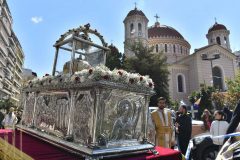
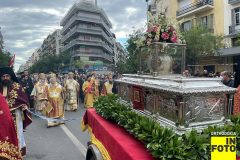
After the singing of the psalms, the Cathedral was absolutely silent. Everyone's attention was focused on the sarcophagus. First His Eminence Metropolitan Vitaly removed the cloth from the icon of the saint (the icon lay in the sarcophagus), and two priests (one monastic, one from the lay clergy), raised it for all to see. Then, the mantle was removed from the coffin, and finally, a key opened the locks, the cover was opened, and the very relics of St. John were visible through the glass. There are no words to describe the feeling of humility and love which overcame all who saw the incorrupt relics of the saint in his white Paschal vestments.

Jul 4, 2009, 10:00

Our Faith : In the Church
The Garments of Salvation
All too often the liturgical garments of the Orthodox Church are simply taken for granted. They are a portion of our ecclesiastical tradition little understood and seldom considered by the laity. We all know what a halo on an icon is and what it represents. Likewise, most of us are at least aware of the complexities and some of the details of our various musical traditions. But I suspect most Orthodox Christians would be hard-pressed to name the diamond-shaped vestment piece that hangs at the priest´s knee (it´s called an "epigonation") or explain the significance.

Jul 3, 2009, 10:00

Discussions and Opinions
Ritual Impurity
What is the meaning of abstaining from Communion during menstruation? What does this say about the female body? What is the meaning of not setting foot in church after giving birth to a child? What statement is being made about childbirth? Most importantly, is the concept of “ritual impurity” congruent with our faith in Jesus Christ? Where did it originate and what does it mean for us today? Let us take a look at the biblical, canonical, and liturgical sources in an attempt to answer these questions.

Jul 2, 2009, 10:00

Discussions and Opinions
“The Social Principles of Jesus” and the Identity of Western Christianity
It is said that Walter Rauschenbusch (1861-1918) was “the leading spokesman for the theology of the Social Gospel in American Protestantism” (from the introduction by Pelikan, 586). Although a Baptist minister, Rauschenbusch apparently rejected biblical literalism in favor of historical criticism—a method of biblical analysis that originated in Rauschenbusch’s fatherland in the first half of the nineteenth century. This method, quite popular even today, allowed Rauschenbusch to see the Gospel through the prism of the contemporary understanding of history, which in the age of social revolutions was dominated by the struggles of the lower classes.

Jul 1, 2009, 10:00

Contemporary Issues
The phoenix is reborn. It's time to fly
Growing up in 1970s Moscow, I had a nanny who had lived in our family for 45 years. She died in 1981, when she was 93 and I was 13. Like most Soviet people, my family was not religious. My grandfather prided himself in becoming an atheist in prerevolutionary Russia and refusing to attend the Orthodox doctrine class at school. It scandalised his father, a priest's son turned high-ranking civil engineer. In Soviet Russia, it was a norm enforced by persecution, education and all-encopassing atheistic propaganda.

Jun 30, 2009, 10:00

Our Faith : Fasting
Thoughts upon Fast
But if we see the fast as an element of life, then it comes out clear that by rejecting life, naturally, we get death. We cannot think by this pattern – “you made a mess now be punished”. That is why Isaac the Syrian uses “warning” and not “menace” or “punishment”. In this case, abstinence, as a physical law, is inherent to a human, to all humans, whether they are believers or not, whether they are righteous or sinners etc. If one were to put his finger in the electric socket and be shocked, of course it is possible for this to be regarded as punishment for a certain deed, but it is also possible for this to be considered a natural consequence.

Jun 29, 2009, 10:00

Sermons, Lectures
Personal Reminiscences of Father Seraphim Rose
Once, when we were walking somewhere on the monastery grounds, I asked him, "Fr. Seraphim, what's your favorite icon of the Mother of God?" (That's the kind of question converts like to ask, you know.) He stopped and said, "I don't have one." "That's impossible!" I said. "Everyone has a favorite icon of the Mother of God. Which one is yours?" He paused again and looked at me, actually with astonishment, and he said, "Don't you understand? It's the whole thing." That was a very profound answer: you can't just pick out one thing and say this is the best thing, or this is my favorite. It truly is everything!

Jun 27, 2009, 10:00

Liturgical Life
Living in the Liturgical Cycles of the Church
The Church sets before us the ideal of daily services, and in earlier times this was not just an ideal, but a norm; this was the standard practice of the Church. But in our time, and especially here in America, daily services have become a rarity, something almost exclusively limited to monasteries and a very few cathedrals. In all honesty, such a situation must be called an aberration.

Jun 26, 2009, 10:00

Sermons, Lectures
On Becoming and Remaining an Orthodox Christian
Recently a priest who has received people into the Church for the last twenty years told me that the list of people whom he has received and who have lapsed is much longer than the list of those whom he has received and who have persevered. That priest is relatively cautious about receiving people, but I know two other parishes where the list of the lapsed is at least twenty times as long as the list of the perseverers.

Jun 25, 2009, 10:00

Family life : In the Family
Reflections on the Spiritual Vocation of the Family
An image of the comfortable family gathered around mother and father at the hearth is not an end in itself. This image is meaningful to the extent it expresses confidence in all those present. To the extent this image is real, it provides a context for the capacity to love life and overcome one's own self-interest and be a servant in the healing of the wounds of life.

Jun 24, 2009, 10:00

Social Life
Orthodox Christians in the Workplace (Part II)
In any work environment, there is informal interaction with coworkers in which almost every topic is discussed. Is it appropriate to "push" your own religion in these discussions, and how do you differentiate between "coercion" and a simple expression of your beliefs? In the course of such innocuous discussions, assumptions will be made that "we all believe in the same God" and that "we are all Christians, right?" The quandary is whether or not to let such an assumption remain, especially if it is unspoken. These are all questions of attitudes and principles which can lead to conflict.

Jun 23, 2009, 10:00

Our Faith : Prayers
Prayer: The Test of Everything
In the Orthodox Church we are taught that the life of faith is dependent upon progress in prayer. Those who grow in the grace of God thus do so because their prayer is genuine, while those who “lose their souls” do so only for one reason: because they refused to give themselves over to God in a life of prayer. St. Theophan the Recluse says, “Prayer is thus the test of everything, the source of everything and the director of everything; for if our prayer is right, then everything else will be right as well.”


Jun 22, 2009, 10:00

Our Faith : Feasts. Calendar
The Feast of All Saints of Russia
Sanctity in the holy Church of Christ did not end in some long-ago century, but has always persevered, and is set as a standard for our own lives here and now. Sanctity did not stop with the Apostles, or the Fathers, or even the New Martyrs of Russia, but reveals itself in the lives of the saints here in North America, some of whom many present here can remember personally. And those who remember, for example, the life of Saint John of San Francisco, know that sanctity is not in spectacular fireworks or drumbeat from the sky, but in taking one’s cross and following Christ

Jun 21, 2009, 10:00

Our Faith
Summer Reading
Along with daily reading of the Scriptures, we should be reading books that motivate us spiritually in a way that is practical and applicable to our lives. The reading of spiritual works that are beyond our understanding or, worse, are inapplicable to our lives only leads to frustration and possibly even spiritual delusion.

Jun 20, 2009, 10:00

Our Faith : Icons
What is blessable as an icon?
One of the great difficulties that I believe the Orthodox Church has always had is control over her iconographers. More than ever, especially today, icons are being painted without understanding, and people who are not steeped in the Orthodox iconographic tradition are taking over our sacred art, teaching and painting, and their icons are ending up on our altars to be blessed, or worse, in our churches to be venerated and prayed before.

Jun 19, 2009, 10:00

Sermons, Lectures
The Spiritual Guide in Orthodox Christianity (Part III)
The task of our spiritual father is not to destroy our freedom, but to assist us to see the truth for ourselves; not to suppress our personality, but to enable us to discover our own true self, to grow to full maturity and to become what we really are. If on occasion the spiritual father requires an implicit and seemingly "blind" obedience from his disciple, this is never done as an end in itself, nor with a view to enslaving him. The purpose of this kind of "shock treatment" is simply to deliver the disciple from his false and illusory "self," so that he may enter into true liberty; obedience is in this way the door to freedom.

Jun 18, 2009, 10:00

Family life
Resentment
When people around us fail to submit and act on cue, according to our directions, the limits of our power over them is exposed and we lash out like a thwarted petty tyrant throwing a tantrum. As this “inner Napoleon,” kicks and screams, he may hurt others, but his ultimate victim is the soul that he inhabits, namely, our own. That’s why resentment so often leaves us feeling far worse than the person against whom our resentment is directed. As someone once said, “Resentment is the poison we drink, hoping someone else will die.”

Jun 17, 2009, 10:00

Our Faith : Sacraments
How Often Should Orthodox Christians Receive Holy Communion?
If we search the canons which the Holy Spirit has given us through the Holy Church, and the teachings of our Holy and Godbearing fathers, then we will find that with one accord and as if with a single voice, they direct us to partake of the Holy Mystery not merely frequently, but constantly.


Jun 16, 2009, 10:00

Sermons, Lectures
The Spiritual Guide in Orthodox Christianity (Part II)
Loving others involves suffering with and for them; such is the literal sense of the word "compassion." "Bear one another's burdens, and so fulfill the law of Christ" (Gal 6:2): the spiritual father or mother is the one par excellence who bears the burdens of others. "A starets," writes Dostoevsky in The Brothers Karamazov, "is one who takes your soul, your will into his soul and into his will."

Jun 15, 2009, 10:00

Our Faith : Feasts. Calendar
Sunday of All Saints
The key, as we Orthodox have always known, is that faith is found not in our words, but in our actions. We live our confession of Christ, we do not simply speak it. A saint is someone who lives according to what he believes. His life is a constant labor to follow the commandments of Christ. His silence speaks volumes. His meekness brings peace to all those around him. His sanctity is a living witness for God. So a saint is a person who has struggled to surrender his passions; who surrendered his or her will to Christ, who for the love of God has abandoned self.


Jun 14, 2009, 10:00

Family life : Before marriage
Walking the Line
We’ve all been there: that place where we feel powerless, where we feel like we have no way out, the place where we fear being alone more than we fear staying. In such a power hungry world, we, as Orthodox Christians, are often taken advantage of due to our forgiving nature. While this occurs in many settings (the boss who treats you as a slave, the sharp tongue of a peer), it most often occurs in romantic relationships.


Jun 13, 2009, 10:00

Social Life
Orthodox Christians in the Workplace (Part I)
Some of the practical conflicts have to do with the daily cycles of Church life: such things as fasting, prayer, and holy days. When we strive to keep the fast, it suddenly seems as though there is a cascade of temptations to break the fast. Office lunches, snacks and munchies, even the rushed lunch necessitating "fast food," all seem to have some element of meat or dairy products.

Jun 12, 2009, 10:00

Sermons, Lectures
The Spiritual Guide in Orthodox Christianity (Part I)
More important than all possible books if we are climbing a mountain for the first time, we need to follow a known route; and we also need to have with us, as companion and guide, someone who has been up before and is familiar with the way. To serve as such a companion and guide is precisely the role of the "abba" or spiritual father — of the one whom the Greeks call geron or geronta and the Russians starets, a title which in both languages means "old man" or "elder."

Jun 11, 2009, 10:00

Photoalbum
The spiritual vertical of human self-existence. Hadzi Miodrag Miladinovic'
Hadzi Miodrag Miladinovic', born in 1957 in Aleksinac, is a Master of photography of FSJ, and a member of ULUPUDS from 1990. He goes in for photography, television and design.

Jun 10, 2009, 10:00

New Russian Martyrs
Extracts from Letters of the Holy New Martyr Grand Duchess Elizabeth to the Martyred Emperor Nicholas II
I took up the life I am now leading not as a cross - but as a road full of light God showed me after Serge's death and which years and years before had begun in my soul. I can't tell you when - it seems to me often that already as a child there was a longing to help those that suffer. Above all those who have moral sufferings…In my life I had so much joy - in my sorrows so much boundless comfort, that I long to give a little of that to others.

Jun 9, 2009, 10:00


Latest Headlines
Contemporary Issues
The phoenix is reborn. It's time to fly
Literature, Culture and the Western Soul
Children's page
Sunday School Fashion
Talking to Children When Bad Things Happen
Family life
Reflections on the Spiritual Vocation of the Family
Resentment
History of Christianity
Foolishness-for-Christ
Faberge Eggs: the Mystery Behind Them
Library
An Underground Story
An Excerpt From Part II of the Way of the Pilgrim
Lives of Saints
Notes of a Pilgrim on the Glorification of St. John of Shanghai and San Francisco, 1994
Blessed Matrona
My Way to Orthodoxy
By Her Prayers...
A Convert to Orthodoxy Reconsiders Evangelicalism
New Russian Martyrs
Extracts from Letters of the Holy New Martyr Grand Duchess Elizabeth to the Martyred Emperor Nicholas II
Life of the Holy New Martyr Grand Duchess Elizabeth
Orthodoxy in the World
Pilgrimage to Mount Athos
Metropolitan Jonah of All America and Canada: "It takes personal sacrifice to be an Orthodox Christian"
Our Faith
The Garments of Salvation
Thoughts upon Fast
Parish
What To Do About A Bad Priest
My Visit to an Orthodox Church
Photoalbum
The spiritual vertical of human self-existence. Hadzi Miodrag Miladinovic'
Photos of Holy Trinity Monastery, Jordanville, New York
Sermons, Lectures
Personal Reminiscences of Father Seraphim Rose
On Becoming and Remaining an Orthodox Christian
Liturgical Life
Living in the Liturgical Cycles of the Church
Living Liturgy: the Liturgical Method of the Fathers
Social Life
Orthodox Christians in the Workplace (Part II)
Orthodox Christians in the Workplace (Part I)
Spiritual music
The Annunciation To The Most Holy Mother of God
Interview with Bishop Hilarion, Composer
Holy Fathers
My Life in Christ - St. John of Kronstadt
The Holy Fathers of Orthodox Spirituality
Discussions and Opinions
Ritual Impurity
“The Social Principles of Jesus” and the Identity of Western Christianity
Theology
About Communion
The Impact of Orthodox Theology


Our Faith | Lifes of Saints | New Russian Martyrs | Analytical articles | Sermons | My Way to Orthodoxy | Parish | Library | Family life | Children's page | History of Christianity | Spiritual music | Service | Orthodoxy in the World